History of World Cup Jerseys
A football jersey is much more than a piece of sportswear: it’s the canvas where each nation projects its identity, history, and pride. From the humble wool uniforms of the 1860s to the technical garments of 2026, here’s how the kit has evolved over more than 150 years.
The origins: wool, flannel, and color (1860–1930)
When the English Football Association codified the rules of football in 1863, players didn’t even wear unified jerseys. Teams distinguished themselves using colored caps or sashes across the chest, and each player wore whatever they had. It was during the 1870s and 1880s that clubs began adopting solid-color flannel or heavy wool jerseys as a symbol of identity.
These early jerseys had high polo-style collars, long sleeves, and weighed between 800 g and 1 kg when soaked with sweat. There were no sizes: the local tailor made each garment to the player’s measurements. The colors — red, blue, striped black — became sacred to fans, though changing kit when two teams shared the same color was an improvised and chaotic process.
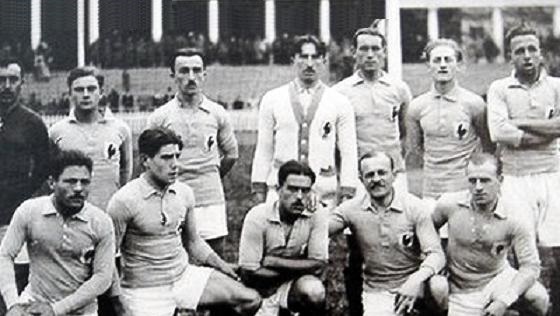 French national team at the 1920 Antwerp Olympics. Dark cotton jerseys and long trousers were the norm of the era. Source: Wikimedia Commons (public domain)
By the 1920s, national teams had set colors and FIFA had begun to standardize the kit. Jerseys were still heavy, but collars had become lower and designs slightly more athletic.
The early World Cups: cotton and simplicity (1930–1958)
At Uruguay 1930, the first World Cup in history, teams took the field in heavy cotton jerseys, with round or polo collars and hand-stitched numbers. The design was purely functional: solid colors or simple stripes that allowed teams to be told apart. Sports sponsor brands and elaborate visual identities didn’t yet exist.
Argentina played that historic final in its classic sky blue and white, and Brazil wore a white jersey — it wasn’t until 1954 that it definitively adopted the canary yellow everyone recognizes today. Cotton, although comfortable at rest, became heavy with sweat and made play difficult in humid climates.
The era of brands: nylon and color (1966–1986)
The arrival of Adidas and Umbro as official World Cup sponsors changed the landscape forever. At Mexico 1970 and Argentina 1978, synthetic fabrics — nylon and polyester — began to take over, lighter and more durable than cotton. It was also the era of bolder designs: wide stripes, geometric checks, and vibrant color palettes reflecting the pop aesthetics of the time.
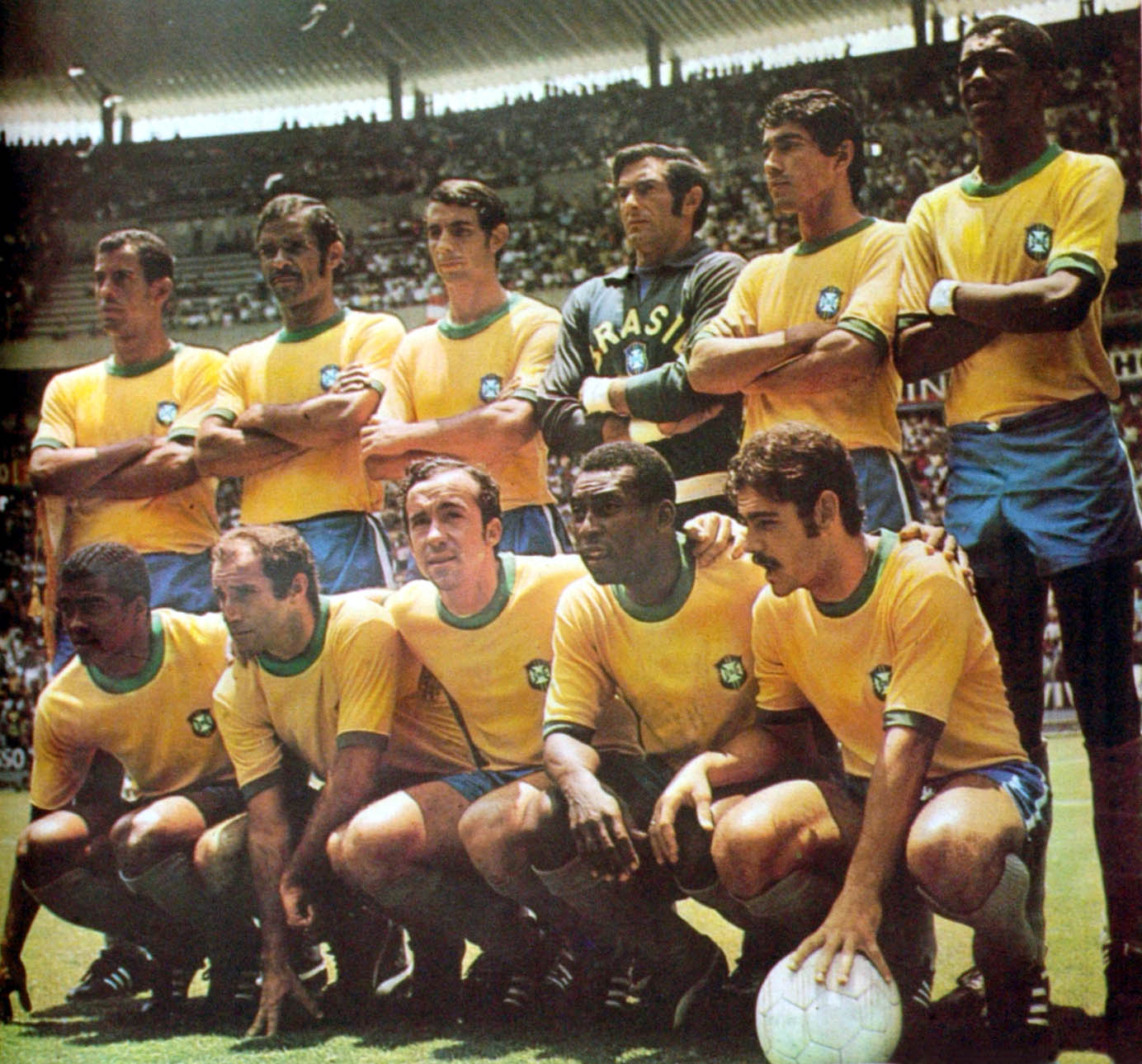 Brazil before the match against Peru, Mexico 1970 World Cup (4-2). The yellow jerseys of Pelé, Jairzinho, and Carlos Alberto became a global football icon. Source: Revista El Gráfico / Wikimedia Commons (public domain)
During this period some of the most iconic jerseys in history were born: Brazil’s yellow at Mexico 1970, Argentina’s striped albiceleste in 1978, and Italy’s mythical azzurro at Spain 1982. The jersey stopped being just clothing and became a cultural symbol.
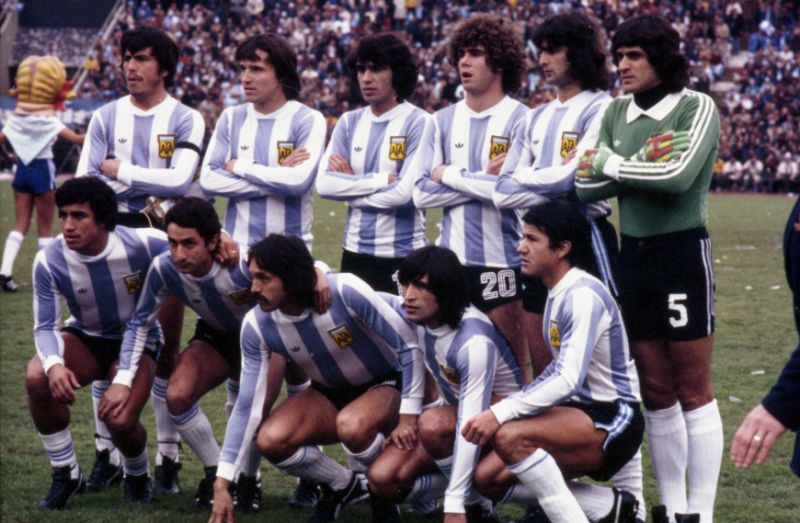 Argentina’s national team at the 1978 World Cup. The fine-striped albiceleste, designed by Le Coq Sportif, is one of the most recognizable jerseys in history. Source: Revista El Gráfico / Wikimedia Commons (public domain)
Technological revolution: technical fabrics (1998–2014)
With the arrival of the 21st century, Nike and Adidas invested millions in textile R&D. At France 1998, the first jerseys with moisture management technology debuted, capable of wicking sweat off the skin in seconds. At Japan-Korea 2002, the kits weighed less than 200 grams — a fraction of the 1880s wool kilos.
By South Africa 2010, technical fabrics had reached astonishing sophistication: ultrasonic seams, three-dimensional meshes, and aerodynamic finishes. The controversial Jabulani — the ball, not the jersey — grabbed headlines, but on players’ backs hung some of the most aesthetically refined kits in history.
From 2018 to 2026: design, heritage, and sustainability
At Russia 2018, France won the world with a minimalist dark blue jersey that is now considered a modern classic. Brands bet on reviving retro elements — classic stripes, large crests, vintage typography — fused with top-tier technology.
For the 2026 World Cup, co-hosted by the United States, Canada, and Mexico, the dominant trend is sustainability: Nike and Adidas make much of their kits from recycled polyester sourced from plastic bottles. At the same time, designers recover culturally-rooted motifs from each nation: pre-Columbian textiles for Mexico, azulejo mosaics for Portugal, sky-blue ombré for Argentina.
A legacy woven match by match
Nearly 160 years separate the wool jerseys of 1863 English clubs from the technical garments of the 2026 World Cup, but the emotional bond tying each fan to the colors of their team remains intact. If you want to find out which are the standout kits of this tournament, we recommend our article on the best jerseys of the 2026 World Cup and the most popular jerseys among fans.
Explore every jersey available in our national teams section and find the one that best tells your story.
Sources and references
- FIFA Museum — Official World Cup history and kit evolution
- Association football kit — Wikipedia — Detailed history of football uniforms
- History of Adidas — Wikipedia — Timeline of Adidas’s football sponsorship
- England national football team kits — Wikimedia Commons — Historic visual archive of kits
- IFFHS — International Federation of Football History and Statistics — Stats and historic data of international football
Continue


