The 5 Most Iconic World Cup Jerseys Ever
Football jerseys are symbols of national identity and living testimony of historic moments. Across World Cup history, some have become legends, gaining value not just for their design but for the historical context in which they were worn.
Here we explore the 5 most iconic jerseys in World Cup history.
1. Brazil 1970: The Perfect Yellow
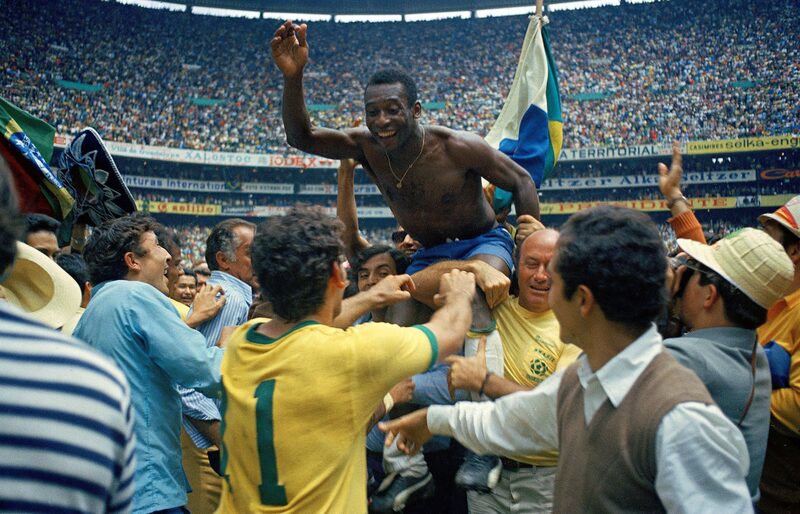 Pelé celebrates the third title after the 4-1 victory over Italy at the Azteca Stadium, June 21, 1970. Source: El Gráfico / Wikimedia Commons (public domain)
Year: 1970 | Manufacturer: Adidas | Iconic player: Pelé | Achievement: Three-time champions
The most iconic jersey in football history. Canary yellow with blue shorts: pure simplicity and perfection. Brazil won the tournament wearing this kit, cementing it as a global symbol of attacking football. It was the first World Cup broadcast in color, and the amarela captured the world’s imagination instantly. More than 50 years later, it remains the reference standard for any sportswear designer.
2. Argentina 1986: Maradona’s Albiceleste
 Diego Maradona with the World Cup trophy after the 3-2 victory over West Germany, Azteca Stadium, June 29, 1986. Source: El Gráfico / Wikimedia Commons (public domain)
Year: 1986 | Manufacturer: Adidas | Iconic player: Diego Maradona | Achievement: Champions
The albiceleste jersey carries historic weight thanks to the legendary moments its stripes witnessed: the ‘Hand of God’ and the ‘Goal of the Century’ against England. The kit became synonymous with Maradona’s mastery. The original shirt he wore in the second half of the quarter-final was auctioned for millions of dollars, cementing its status as an unrepeatable sporting relic.
3. Germany 1990: Revolutionary Geometry
 Germany West vs Yugoslavia (4-1), San Siro, Milan, June 10, 1990. Photo: Wikimedia Commons (CC BY 3.0)
Year: 1990 | Manufacturer: Adidas | Achievement: Champions | German Reunification
A turning point in sportswear design. The horizontal stripes in black, red, and gold arranged in a geometric pattern were bold for the time. Adidas introduced a style that broke from tradition and won the title for Germany. This was also the first World Cup under reunified Germany, blending tradition with modernity in every stitch.
4. Netherlands 1974: The Dutch Orange
 Johan Cruyff in the orange Netherlands jersey, 1974. Photo: Rob Mieremet / Anefo — Dutch National Archives (CC0)
Year: 1974 | Manufacturer: Adidas | Iconic player: Johan Cruyff | Achievement: Runners-up
Simple and iconic. The bright orange is a symbol of Dutch national identity. There’s a fascinating anecdote: while Adidas sponsored the national team, Puma sponsored Cruyff, who got a customized version with only two sleeve stripes instead of Adidas’s standard three. Although the Netherlands didn’t win, the jersey remains synonymous with Total Football and one of the most elegant styles in history.
5. England 1966: Red and Eternal
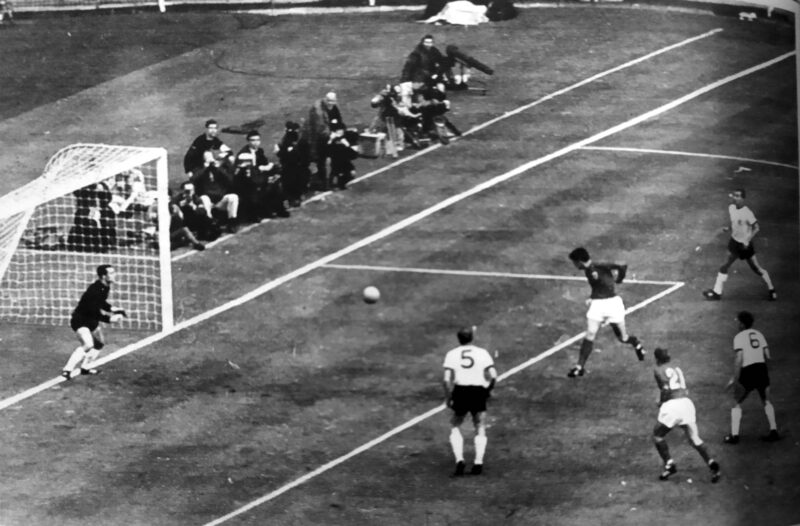 Geoff Hurst heads the ball toward the German goal in the Wembley final, July 30, 1966. Source: El Gráfico / Wikimedia Commons (public domain)
Year: 1966 | Manufacturer: Umbro | Achievement: Champions | England’s only title
White shorts, long-sleeved red shirt. So simple, so perfect. A magical jersey for a magical tournament. It’s memorable not only for its minimalist design but for witnessing England’s only World Cup title. It represents a moment of national glory that, nearly 60 years on, remains the ultimate benchmark of English football.
Why these jerseys matter
World Cup jerseys transcend their function as sports uniforms. They become intergenerational symbols that link historic moments to national identities.
From Brazil’s yellow in 1970 to England’s red in 1966, every jersey tells a story of glory, innovation, and passion. Leading brands — Adidas, Nike, Umbro, Puma — invest significant resources in research and advanced design, but the real value lies in the stories they carry.
Conclusion
Iconic World Cup jerseys will remain immortal references in global sports culture, reminding us that sometimes a simple garment can hold the essence of a country, the genius of its players, and the dreams of millions of fans.
As the 2026 World Cup approaches, new jerseys are ready to write their own stories. If you want to find out which ones stand out this tournament, we recommend our articles on the best jerseys of the 2026 World Cup and the full history of World Cup jerseys.
Sources and references
- SI Deportes — The 50 best football jerseys in history
- Garment Printing Spain — The 10 best jerseys in World Cup history
- Diario Las Américas — The most famous jerseys on the road to the 2026 World Cup
- Fútbol Emotion — The most beautiful football jerseys
- Fútbol Viajes — The most famous football jerseys in history
Continue

